Crypto Regulation Compared: How the US, EU and Asia Approach Crypto
The EU has one rulebook (MiCA), the US regulates through existing agencies and new stablecoin law, and Asia ranges from licensing hubs to outright bans. Here is how they compare and what it means for traders.
By SorooshX R&D TeamUpdated Oct 28, 20262 min read
Also in: العربية · Español · فارسی · Türkçe · 中文
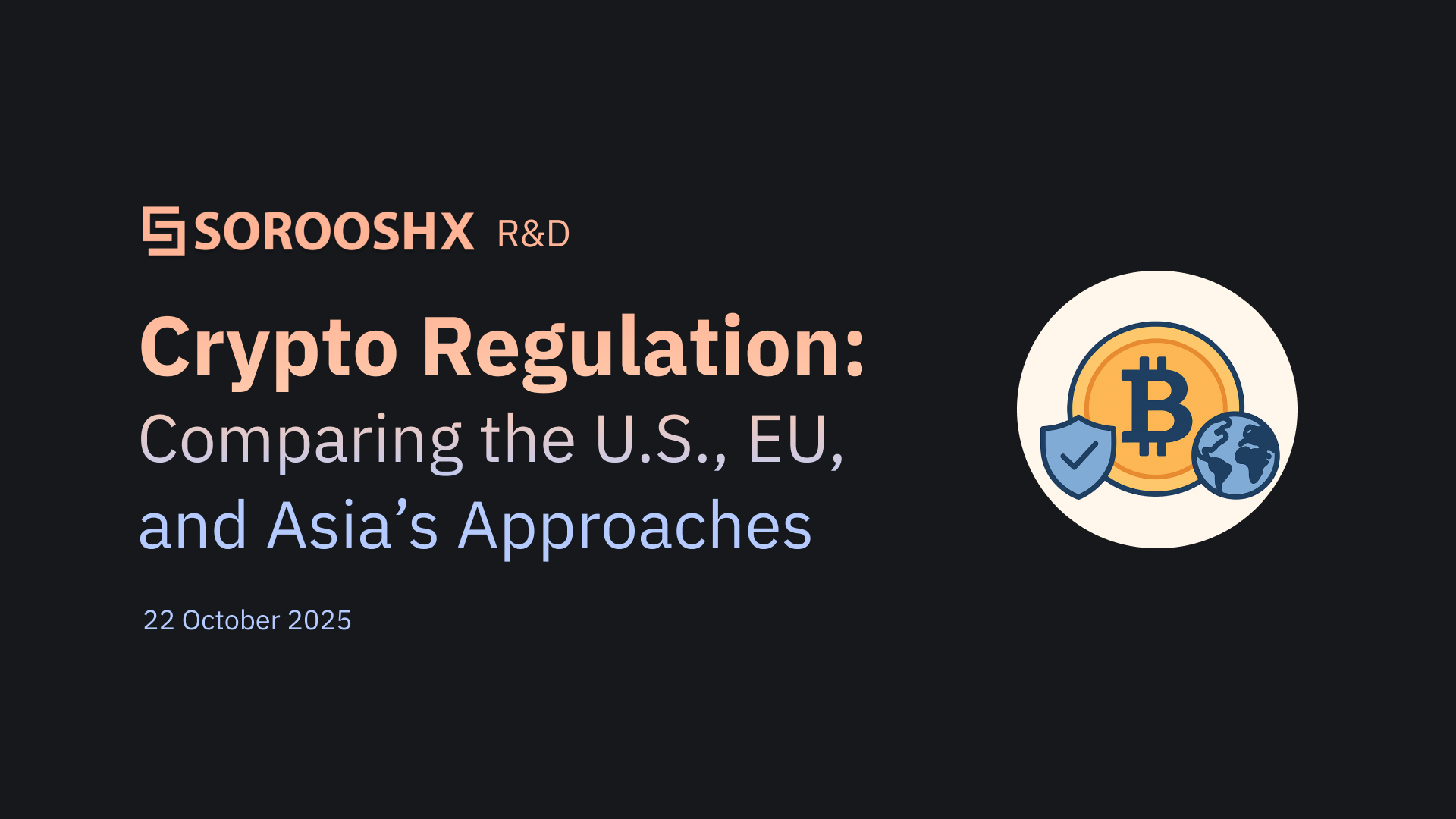
Crypto regulation looks very different depending on where you live. The European Union has written one rulebook for the whole bloc. The United States regulates crypto through existing agencies and, since 2025, a federal stablecoin law. Asia ranges from licensing hubs like Singapore and Hong Kong to a full ban in mainland China. This guide compares the three in plain language and explains what a trader on SorooshX should check.
What every regulator cares about
Across countries the goals are similar: protect customers from fraud and misleading promotions, stop money laundering and sanctions evasion, keep stablecoins properly backed, and keep markets fair. The differences are in how they get there: detailed rules written in advance, or enforcement case by case.
Nearly all major markets now apply the travel rule from the Financial Action Task Force (FATF): when a regulated platform sends crypto, it must pass identifying details about the sender and receiver, just as banks do for wire transfers.
European Union: one rulebook (MiCA)
The Markets in Crypto-Assets Regulation (MiCA) entered into force in June 2023. Its stablecoin rules applied from June 2024, and its rules for crypto-asset service providers from December 2024.
- Exchanges, brokers and custodians need a licence; one licence works across all EU countries.
- Stablecoin issuers must hold reserves, publish white papers and honour redemptions.
- Market-abuse rules, like those for stocks, now cover crypto.
The result is clear rules and higher compliance costs. Some products have been withdrawn from EU users as a result.
United States: agencies first, laws catching up
The US has no single crypto law. Instead:
- The SEC decides whether a token is a security using the Howey "investment contract" test and has brought many enforcement cases.
- The CFTC treats bitcoin and similar assets as commodities and oversees crypto futures and derivatives.
- In 2025 Congress passed the GENIUS Act, the first federal framework for payment stablecoins.
Broader market-structure legislation has been debated for years. For traders, this means rules can shift with court rulings and agency leadership.
Asia: from licensing hubs to bans
- Japan: exchanges must register with the Financial Services Agency and keep customer assets separate.
- Singapore: the Monetary Authority of Singapore licenses digital payment token services and limits marketing to the public.
- Hong Kong: the Securities and Futures Commission licenses virtual asset trading platforms, with a regime that started in June 2023.
- South Korea: exchanges must partner with banks for real-name accounts.
- Mainland China: crypto trading services have been banned since 2021.
Crypto regulation at a glance
| EU | US | Asia (examples) | |
|---|---|---|---|
| Approach | One rulebook | Agencies + new laws | Country by country |
| Stablecoins | MiCA reserve rules | Federal law (2025) | Licensing in HK, SG, JP |
| Exchange licence | Yes, EU-wide passport | State and federal rules | Yes in JP, SG, HK; banned in CN |
What this means if you trade on SorooshX
SorooshX is a non-custodial, on-chain exchange: you trade from your own wallet and SorooshX never holds your funds. That does not put you outside the law. Rules on trading, leverage and taxes apply to you where you live. SorooshX is not available in the United States or in OFAC-sanctioned jurisdictions. Before trading, check your local rules, and read our overview of where crypto regulation is heading.
Market commentary, not investment advice. Leveraged products can lose more than your margin.
Frequently asked questions
What is MiCA?
MiCA is the EU's Markets in Crypto-Assets Regulation (EU 2023/1114). It entered into force in June 2023; its stablecoin rules applied from June 2024 and its rules for crypto service providers from December 2024. A licence in one EU country can be used across the bloc.
Who regulates crypto in the United States?
Several agencies. The SEC treats some tokens as securities using the Howey test, the CFTC oversees commodities such as bitcoin and crypto derivatives, and banking regulators oversee banks. A 2025 federal law created a framework for payment stablecoins.
Which Asian countries allow crypto trading?
Japan, Singapore, Hong Kong and South Korea allow it under licensing or registration rules. Mainland China has banned crypto trading services since 2021. Rules differ widely, so check your own country.
Can I use SorooshX from any country?
No. SorooshX is not available in the United States or in OFAC-sanctioned jurisdictions, and you are responsible for following the rules where you live.
Sources
- 1.EUR-Lex: Regulation (EU) 2023/1114 (MiCA)
- 2.SEC: framework for investment contract analysis of digital assets
- 3.CFTC: digital assets
- 4.Congress.gov: GENIUS Act (S.1582)
- 5.FATF: virtual assets and the travel rule
- 6.Japan Financial Services Agency
- 7.Monetary Authority of Singapore
- 8.Hong Kong Securities and Futures Commission
Read next
 The Future of Crypto Regulation: Five Trends Every Trader Should KnowCrypto rules are converging on a few themes: stablecoin reserves, licensed platforms, the travel rule, automatic tax reporting and open questions about DeFi. Here is what each trend means for you.
 Ethereum After the Merge: How Proof of Stake and Layer 2s Shape ETHThe Merge moved Ethereum to proof of stake in 2022. Since then, staking withdrawals, cheaper layer-2 data and wallet upgrades have changed how ETH works. Here is what changed and what to watch.
 A Short History of Crypto: From the Bitcoin Whitepaper to On-Chain TradingCrypto went from a nine-page paper in 2008 to a global market with its own exchanges, stablecoins and regulated funds. Here are the moments that shaped it and what each one means for traders today.
 What are POS and POW? the differences between POS (Proof Of Stake) and POW (Proof Of Work)!
 The Importance of Understanding Blockchain Layers: Navigating the Evolving Landscape of Cryptocurrencies and Decentralized Applications
 Web 3.0: The Future of the Internet